

Cara Menghilangkan Sedimen Dari sumur pompa
Sumur Pompa atau mata air dapat diisi dengan sedimen, katup penyumbat, perlengkapan, dan sistem irigasi dan penghancuran pemanas air dan peralatan. Meskipun filter cartridge sedimen banyak tersedia di toko perangkat keras, filter ini seringkali berukuran kurang atau menggunakan jenis penyaring yang salah untuk jenis sedimen yang ada di dalam air. Hasilnya sering terjadi penurunan tekanan, laju alir berkurang dan seringnya perawatan.
Dengan filter yang benar untuk sedimen yang ada, hanya sedikit tetes yang pasti, dan perawatan dijaga seminimal mungkin.
Ada lima jenis filter sedimen utama yang paling berguna untuk air sumur dan mata air:
• Strainer saringan bawah & saringan wye
• Pemisah sentrifugal
• Sistem penyaring kartrid
• Filter media backwashing
• Sistem membran ultra-Filtra on (UF)
Pertanyaan untuk Tanya Saat Memilih Saringan Sedimen:
• Jenis sedimen apa yang saya miliki di sistem air saya?
• Berapa laju alir dalam galon per menit yang ingin saya saring?
• Apa tekanan garis saya di PSI?
• Jenis atau kombinasi jenis filtrasi yang harus saya gunakan?
• Apakah saya memiliki sedimen sub-mikron atau kekeruhan yang tidak dapat disaring oleh filter standar dan memerlukan filtrasi atau flokulasi ultra dikombinasikan dengan penyaringan? Uji Air Anda
Ini mungkin terlihat seperti sedimen pada saat Anda melihatnya di mangkuk toilet atau binatu, tapi seringkali apa yang kita anggap sebagai sedimen sebenarnya adalah logam terlarut seperti besi atau mangan yang beralih ke partikel padat hanya setelah mereka memasuki pipa ledeng rumah tangga. Analisis air dasar selalu merupakan ide bagus saat menentukan jenis filter sedimen yang terbaik untuk kebutuhan Anda.
Analisis mineral umum akan menyediakan daftar mineral umum. Item penting untuk diuji meliputi:
• pH
• Kekerasan (kalsium karbonat)
• Besi
• Mangan
• Total padatan terlarut Noda dan Bau
Jika air berubah warna, atau memiliki bau yang kuat, Anda mungkin juga ingin menguji:
• Bakteri Besi
• Tannin
• Analisis Profesional Hidrogen sulfida atau Kit Uji Rumah?
Jika Anda mencoba untuk menghilangkan sedimen atau menghilangkan zat besi, mangan atau bau, alat uji rumah yang dapat Anda lakukan sendiri dapat bekerja dengan baik. EPA merekomendasikan pengujian air Anda setiap tahun untuk bakteri coliform dan nitrat.
Untuk menemukan laboratorium lokal, berkonsultasilah dengan departemen kesehatan daerah Anda untuk mendapatkan rekomendasi.
Sampel air harus digambar sedekat mungkin dengan sumbernya, sebelum sistem filtrasi.
Lakukan 'Inspeksi Tangki Toilet'
Kecuali tangki toilet Anda baru atau baru saja dibersihkan, tangki penyiraman toilet Anda bisa menjadi sumber informasi kualitas air yang bermanfaat! Cukup hidup penutup dan lihatlah.
| ymptom | Cause | Solution |
| White scale on float | Calcium hardness | Water softener |
| White scale on float | Total dissolved solids | Reverse osmosis |
| Tank sides are white, but black, rust or sand is laying on the bottom | Decaying galvanized pipes | Replace pipes; correct corrosiveness of water |
| Sand, rust or sediment in well water | Sediment and/or iron filter | |
| Blue Stains | Acidic (low pH) water | Calcite neutralizer or soda ash feeder |
| Rust Stains | Iron | Iron filter (Birm, MangOX, Greensand, Pyrolox) |
| Furry, stringy red growths | Iron (and/or other) bacteria | Chlorination, aeration, ozone injection, hydrogen peroxide, followed by filtration |
| Furry, stringy gray or black growths | Sulfur (or other) bacteria | Chlorination, aeration, ozone injection, hydrogen peroxide, followed by filtration |
| Frothy, with bubbles | Iron bacteria | Chlorination, aeration, ozone injection, hydrogen peroxide, followed by filtration |
| Brown stains | Iron And/or Manganese | Iron filter that removes manganese (MangOX, Greensand, Pyrolox) |
| Black Stains | Iron And/or Manganese | Iron filter that removes manganese (MangOX, Greensand, Pyrolox) |
| Ferric Sulfide (black rust) | Iron filter (Birm, MangOX, Greensand, Pyrolox) | |
| Pink Stains | Airborne bacteria | Not water quality related; Clean with chlorine bleach |
Check For Sediment in Water Heater
Water heaters can not only trap sediment but actually create and introduce sediment into your water.
Common forms of sediment introduced by the water heater:
| Type of Sediment | Caused By |
| Blue or gray chips | Decaying dip tube |
| Black or sandy sediment | Decaying glass liner |
| Black, orange or gray flakes | Decaying anode rod |
It is recommended that you drain your water heater at least once per year. This is not only quick and easy to do, this will flush out sediment that may accumulate in the bottom and give you an idea of the sediment type and color , if any, are present.
Connect a garden hose to the bottom drain on your water heater and open the valve and run the water into a white 5 gallon bucket.
Check for Pipe Corrosion and Scale Build-up
Your pipes can introduce sediment into your water if they are corroding. Unless your home is new, it is important to check for pipe corrosion scale build-up in the piping. Fortunately this is not difficult to do by using one of the following methods:
- • Check for signs of blue stains in fixtures, blue stains in toilet tanks, which can indicate copper corrosion, and/or test water for copper.
- • If you have galvanized iron pipe, look for signs of rust and rustcolored scale in the toilet flush tank.
- • If possible, inspect the exterior of pipes and valves, to see if you see any signs of pinhole leaks or corrosion by-products which can be crusty, bluish, white or salty looking or rusty. If you are having any plumbing work done on your house, inspect any sections of the pipes that have been cut to see if there is any scale build-up or signs of corrosion.


Water heaters can accumulate sand rust and sludge. If the water heater is corroding ‘sediment’ can actually be introduced into the water.


Determine Your Well Pump Flow Rate
Your well pump can pump water up to a certain maximum flow rate, in gallons per minute. For example say you could fill a 5 gallon bucket in 1 minute. This is a flow rate of 5 gallons per minute or 5 GPM. If the water filled up a 5 gallon bucket in 30 seconds, the flow rate would 10 GPM. Knowing how many gallons per minute your water system can pump is critical to picking the right type of water treatment system, and it is easy to determine.
This method works for most well pumps. If your pump turns on at one pressure (typically 30 or 40 PSI) and off at a higher pressure (usually 50 or 60 PSI) this method will work for you.
It is easy! All you need is a 1 or 5 gallon bucket and a watch or clock. It takes just a few minutes:
1. Open any hose bib or faucet until pump turns on.
2. Close hose bib or faucet and let pump fill up pressure tank until it turns off.
3. Using a 1 or 5 gal. bucket, open faucet, collect and measure all water discharged until pump turns on.
4. When pump turns on, immediately close faucet and start timing pump cycle*
5. When pump turns off, record pump cycle time to refill pressure tank in seconds.
6. Divide the number of gallons collected in Step 3 by the number of seconds in Step 5.
7. Multiply the answer from Step 6 by 60.
8. The answer in Step 7 is the average pumping capacity of the pump in gallons per minute (GPM).
1. Open any hose bib or faucet until pump turns on.
2. Close hose bib or faucet and let pump fill up pressure tank until it turns off.
3. Using a 1 or 5 gal. bucket, open faucet, collect and measure all water discharged until pump turns on.
4. When pump turns on, immediately close faucet and start timing pump cycle*
5. When pump turns off, record pump cycle time to refill pressure tank in seconds.
6. Divide the number of gallons collected in Step 3 by the number of seconds in Step 5.
7. Multiply the answer from Step 6 by 60.
8. The answer in Step 7 is the average pumping capacity of the pump in gallons per minute (GPM).
Pressure Tank with Submersible Well
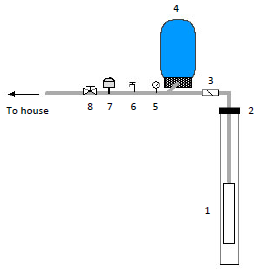 How It Works: Submersible pump in well (1) is controlled by pressure switch (2). When pressure in pressure tank (3) drop below a preset level (typically 40 to 60 PSI) the pressure switch turns on well pump. Well pump continues to run until pressure in pressure tank builds up, and pressure switch reaches maximum pressure setting. The pressure tank contains a precharged air bag to moderate pressure in the piping system.
1 Well pump submerged in water
2 Well head with sanitary seal
3 Check valve (may be submerged in well and not visible)
4 Pressure switch
5 Pressure gauge
6 Pressure tank
Sediment, Flakes and Particles Identification Chart
| Flakes or Particles | Cause | Possible Remedy |
| Black flakes, grit | Lining of water heater deteriorating | Replace water heater |
| Black grit or particles | Manganese | Greensand filter or MangOX filter |
| Iron sulfide “black rust” | Chlorination with iron filtration | |
| Corrosion from lining of galvanized pipe | Replace galvanized pipe with copper or plastic pipe | |
| Blue chips | Water heater dip tube deteriorating | Replace water heater |
| Blue or green flakes | Copper-stained calcium particles from copper pipe corrosion | Check pH of water and neutralize acid pH |
| Dirt color sediment | Sediment from well water | Sediment backwash filter, or cartridge type filter; ultrafiltration |
| Gray sand or grit | Sand or dirt from well water | Sediment backwash filter, or cartridge type filter |
| Water heater liner deterioratng | Replace water heater | |
| Red, yellow or orange beads | Water softener resin from broken water softener | Repair or replace water softener |
| Rust, orange flakes | Rust and iron from well water | Sediment backwash filter, and/or iron filter |
| Iron bacteria | Chlorination with iron filtration | |
| Rust from corroded iron pipes | Replace corroded iron pipes | |
| Sand or grit | Sand from well | Sand separator or Spin-Down filter strainer |
| White or tan flakes | Clay or calcium particles from well water | Sediment filter |
| Calcium carbonate (water hardness) | Water softener | |
| White plastic chips | Water heater dip tube deteriorating | Replace water heater |
| Gray particles suspended in water | Colloidal clay | Ultrafiltration (UF) membrane |
Sediment Filter System Types:
- • Mesh screen “spin-down” filter strainers: 100 to 500 micron range, remove sand and larger sediment
- • Centrifugal separators: 40 microns and up, remove large sand and sediment
- • Micron cartridge filters: 0.5 to 100 micron range, remove fine sediment and grit
- • Sediment backwash filters: filter down to 5 to 10 micron range and are self-cleaning. Often used in conjunction with 1 to 5 micron cartridge filters.
- • Ultrafiltration membranes (UF): filter down to less than 0.15 microns. Remove bacteria; very fine colloidal sediment.
What is a micron? A micron is another measurement of particle size. A micron is one-millionth of a meter or one twenty-five thousandth of an inch.
A human hair is approximately 50 to 100 microns in diameter. Bacteria range in size from approximately 10 microns down to less than 1 micron. Most large sediment such as grit, flakes and small particles that enter homes from wells are in the range of 1 to 200 microns.

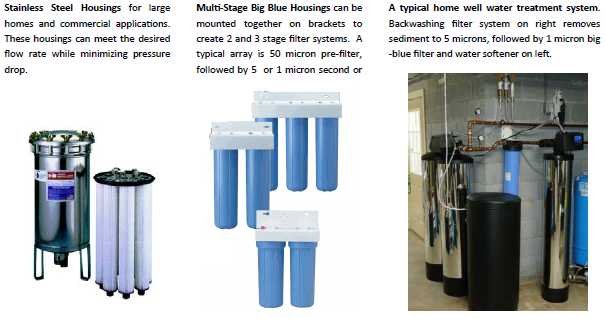
Sediment backwash filter followed by 1 micron filter and water softener. Removes sediment, iron and softens water.

Two-stage big blue filter for home. First stage is 50 micron, second state is dual-grade 25/1 micron filter.

Filter Strainers with Mesh Screens
Spin Down Filter Strainers
Spin down filters use screens of varying sizes to remove large sediment and grit from water. A typical practical size for home water wells is either 60 (250 microns) or 100 (150 microns) mesh.

Wye Strainers
A wye strainer has an internal screen with a large 20 mesh screen. It is used to keep large sand or foreign objects out of piping systems. A hose bib or valve can be installed on the screen “Y” section to allow flushing of the strainer.

Mesh Size to Micron Chart
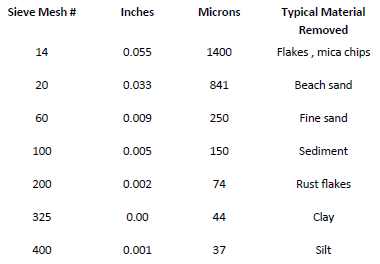
What does mesh size mean?Figuring out mesh sizes is easy. All you do is count the number of openings in one inch of screen (in the United States, anyway.) The number of openings is the mesh size. So a 4-mesh screen means there are four little squares across one linear inch of screen. A 100-mesh screen has 100 openings, and so on. As the number describing the mesh size increases, the size of the particles decreases. Higher numbers equal finer material.
How fine do screens get? That depends on the wire thickness. If you think about it, the finer the weave, the closer the wires get together, eventually leaving no space between them at all. For this reason, beyond 325-mesh particle size is usually described in “microns.”
What is a micron? A micron is another measurement of particle size. A micron is one-millionth of a meter or one twenty-five thousandth of an inch.
Why use a 50 micron filter cartridge, why not use just a 50 micron strainer instead?
Normally for well water systems, we do not recommend filter strainers less than about 200 mesh or 74 microns. The strainers can become clogged too quickly. Its better to use filter strainers for large sediment such as sand or grit. Filter cartridges and backwash filters have larger surface areas and don’t become clogged and cause pressure loss like very fine mesh strainers will.
Normally for well water systems, we do not recommend filter strainers less than about 200 mesh or 74 microns. The strainers can become clogged too quickly. Its better to use filter strainers for large sediment such as sand or grit. Filter cartridges and backwash filters have larger surface areas and don’t become clogged and cause pressure loss like very fine mesh strainers will.
Centrifugal Separators
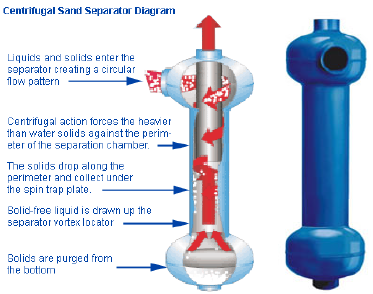 In a centrifugal sand separator the water rushes through the device and centrifugal force slings large particles, sand, debris and sludge outward to the separator wall and downward in a spiral motion.
Gravitational force pulls the separated solid particles downward past the spin trap plate into the solids holding chamber. Cleaned water then rises through the vortex locator and returns back to the plumbing system.
These systems have no screens, slotted baffles, moving parts or filter media so there is no pressure loss.
No maintenance is required, however periodic opening of the purge valve is necessary to flush out accumulated solids. Purging can be done manually or an automatic flush valve can be used.
 How It Works:Submersible pump in well (1) is controlled by pressure switch (8). When well pump runs water flows through centrifugal separator and solids are separated out.
1. Well head
2. Centrifugal separator
3. Manual flush valve
4. Check valve
5. Pressure tank
6. Pressure gauge
7. Hose bib
8. Pressure switch
9. Gate valve
Sediment Backwash Filters
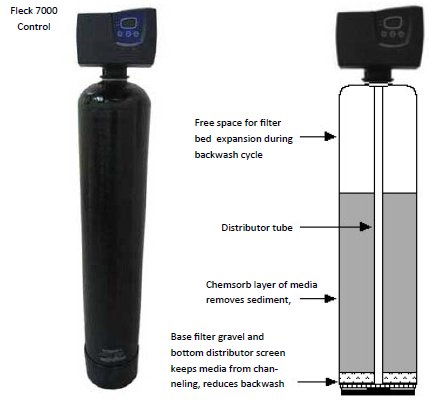 • Removes sediment and turbidity with no filter cartridges or maintenance
• Natural zeolite mineral filters water to 5 micron range
• Auto backwash & rinse keeps media clean
• Little or no pressure drop through filter
• Rugged media lasts for years
• Lighter than sand but filters finer
• Lower backwash flow rate requirements than traditional sand filters
3-Stage Sediment Removal
How it Works:
 Water first flows through filter strainer removing sand and large sediment and flakes. An optional auto-flush valve keeps filter mesh screen clean, or it can be manually flushed by opening bottom flush valve.
Next the water flows through automatic backwashing sediment backwash filter where most of the turbidity and sediment is removed down to 5 microns. Accumulated sediment is automatically flushed out to drain restoring water pressure.
After the sediment backwash filter the water is further filtered to 1 micron removing all particles over 1 micron.
Micron Cartridge Filters
 Filter cartridges are widely used in home water systems and come in a variety of sizes and micron ratings. A micron rating of 50 microns for example means that approximately all particles 50 micron in size and up will be trapped by the filter.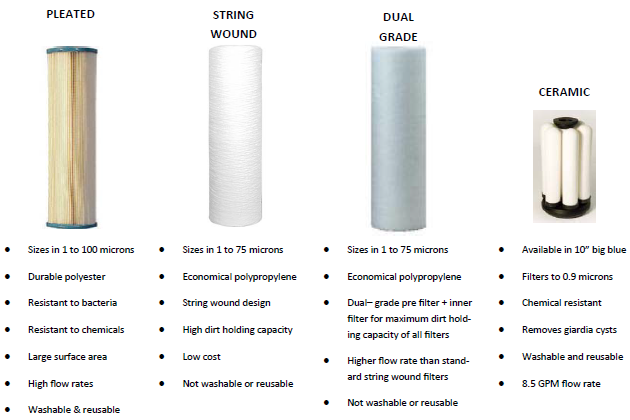
Ultra-Filtration Membrane Systems
 Some particles are less than 1 micron and cannot be removed by conventional micron filter cartridges. These sub-micron particles can cause water to be cloudy or discolored, or harbor bacteria.
An ultra-filtratin or “UF” membrane system filters water down to less than 0.015 microns, effectively removing bacteria, cryptosporidium cysts, and very fine sediment and colloidal clay particles.
The result is crystal clear water with no bacteria or sediment.
UF Systems
 • Remove all particles down to the 0.020 to 0.015 micron range.
• Remove turbidity, cysts and bacteria
• Use Hollow-fiber membrane that are cleaned by simple backwashing
• Require normal line pressure to operate
• Retain natural minerals. Does not desalinate
• Pre-filter water to 1 to 5 microns before UF
Antunes© UF system with filtration

Flocculation Aids
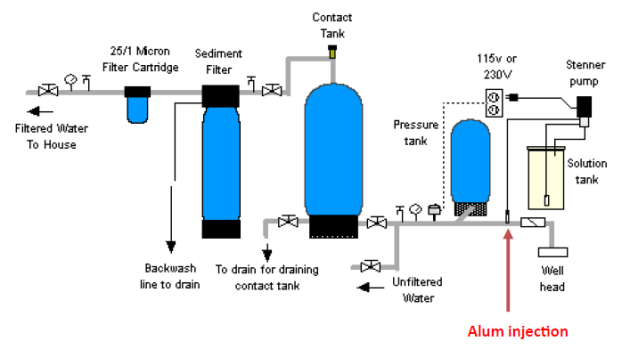
 Some natural waters contain tannin, organic matter, color and/or super fine particles called colloids that cannot be practically removed filtration without first pre-treating it with a flocculent. After the non-toxic chemical is injected, it combines with these fine colloidal particles to form ‘floc’, which is a larger mass of these particles. The floc is then easily filtered out with autobackwashing sediment filters or cartridge filter systems.
Common Flocculants Include:
• Alum (aluminum sulfate)
• Ferrous sulfate
• Chitosan (from crustaceans)
• Alginates
• Alum (aluminum sulfate)
• Ferrous sulfate
• Chitosan (from crustaceans)
• Alginates
Residential Well Water Flocculation and Filtration System
Identify Pipe Sizes
It is useful to know the size of your incoming pipes. For instance, sayyou decide you want to in stall calcite neutralizer for your house. They come in different pipe sizes, such as 3/4″ pipe, 1″ pipe etc. Generally, you want to make certain you get a system that will not restrict the water flow or pressure, so if you have a 1″ pipe, you would want a calcite
neutralizer that has 1″ pipe connectors. Knowing what size piping you have solves this problem.
neutralizer that has 1″ pipe connectors. Knowing what size piping you have solves this problem.
It is easy to check the size of your pipes. First, check on the pipe itself, often it will be labeled or written on the side. If not, the string method which measures the circumference is probably the best way to determine
your pipe size. Circumference is the distance it takes to go around the pipe once.
your pipe size. Circumference is the distance it takes to go around the pipe once.
Remove any insulation from the pipe. Using a piece of string about 6″ long (or a cloth tape measure) wrap the string around the pipe once and measure to the nearest 1/8 of an inch. Once you have found the circumference, use the chart below to find your pipe or tube size.
Pipe Circumference to
Pipe Size Chart
Copper Pipe or PEX tubing
2.75″ (70mm) = 3/4″ pipe
3.53″ (90mm) = 1″ pipe
4.32″ (110mm) = 1 1/4″ pipe
5.10″ (130mm) = 1 1/2″ pipe
2.75″ (70mm) = 3/4″ pipe
3.53″ (90mm) = 1″ pipe
4.32″ (110mm) = 1 1/4″ pipe
5.10″ (130mm) = 1 1/2″ pipe
Steel Pipe or PVC Plastic Pipe
3.25″ (83mm) = 3/4″ pipe
4.00″(102mm) = 1″ pipe
5.00″(127mm) = 1 1/4″ pipe
6.00″(152mm) = 1 1/2″ pipe
3.25″ (83mm) = 3/4″ pipe
4.00″(102mm) = 1″ pipe
5.00″(127mm) = 1 1/4″ pipe
6.00″(152mm) = 1 1/2″ pipe
Flexible Polyethylene Pipe
2.96-3.33″ (75-85mm) = 3/4″ pipe
3.74-4.24″ (95-108mm) = 1″ pipe
4.90-5.57″ (124-141mm) = 1 1/4″ pipe
5.70-6.28″ (145-160mm) = 1 1/2″ pipe
2.96-3.33″ (75-85mm) = 3/4″ pipe
3.74-4.24″ (95-108mm) = 1″ pipe
4.90-5.57″ (124-141mm) = 1 1/4″ pipe
5.70-6.28″ (145-160mm) = 1 1/2″ pipe
Why do they call it 1/2″pipe?!
Strangely, there is nothing about a ½ pipe that is ½, be it copper, iron, or PVC. The outside diameter of copper is 5/8″, and the inner diameter is either 0.527″, 0.545″, or 0.569″, depending on the series.
So-called ½ galvanized iron pipe is 0.840″ outside diameter and 0.622″ inside. PVC is the same outside as iron pipe, but it is 0.608″, 0.528″, or 0.480″ inside.
If no dimension is ½, why call it ½ pipe?
Many years ago (copper pipe was introduced in the 1930’s) copper pipe was indeed standardized at the nominal diameter inside with a 1/16″ wall, making it 1/8″ bigger on the outside. As the metallurgy improved, allowing manufacturers to use thinner metal (and thus increase profits), they increased the inner diameter rather than decrease the outer diameter simply to allow the pipe fit existing fittings.
As the manufacturers began to make bigger and bigger pipe, they found that 1/16″ wall thickness was insufficient. Thus, the inner diameter of larger pipes is smaller than the nominal size, while smaller pipes are larger.
Sediment Removal CHEAT SHEET


Tidak ada komentar: